Section 01
An eclipse is an alignment, not a global light switch
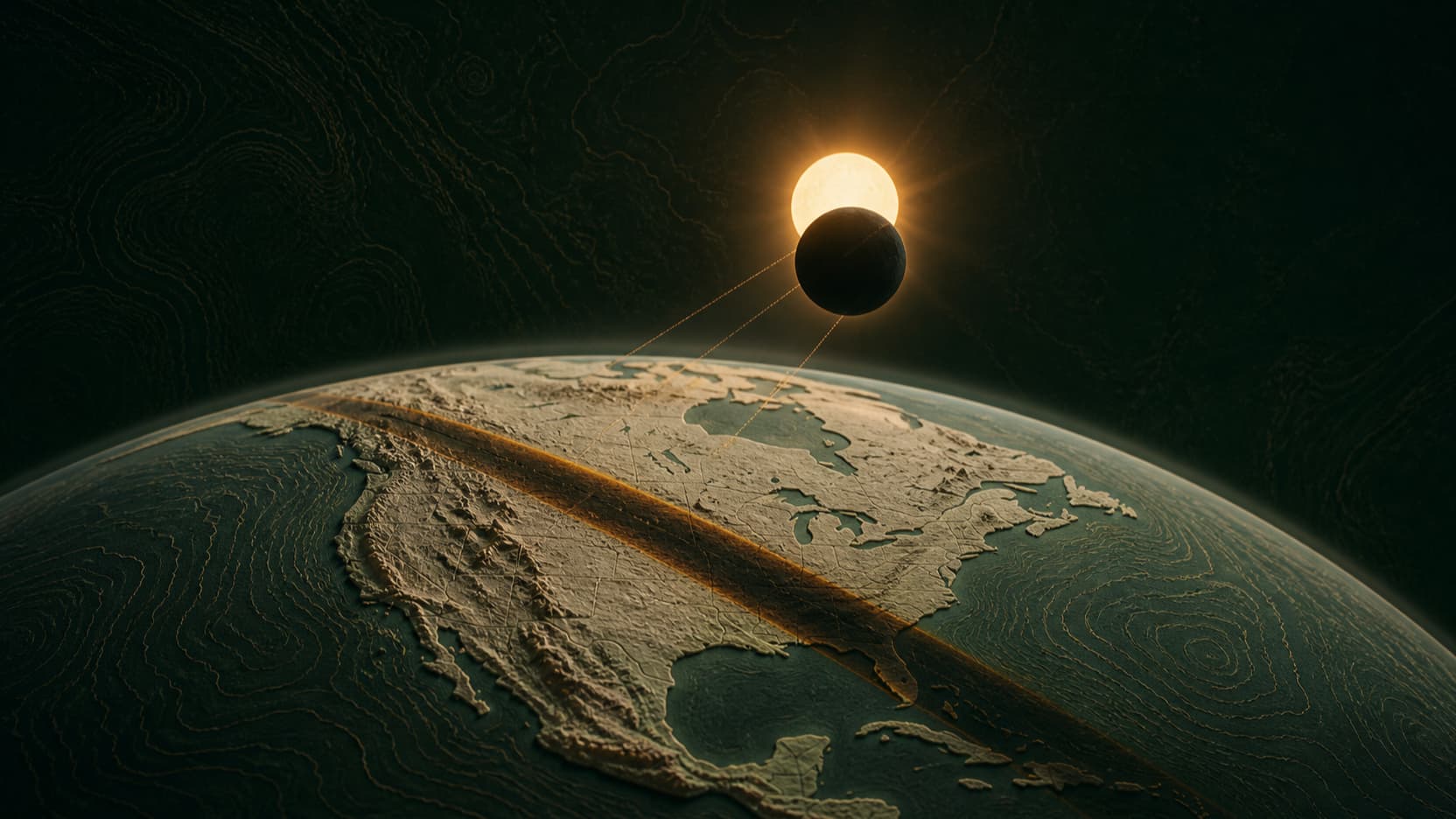
A solar eclipse happens when the Moon passes between Earth and the Sun near new moon. The Moon blocks some or all of the Sun from a narrow set of viewing locations. The event is global astronomy, but the experience is intensely local: every observer occupies a different point inside or outside the moving lunar shadow.
That is the first idea a flat diagram tends to hide. The Moon is not simply covering a picture of the Sun. Its shadow is crossing a rotating, curved Earth while the observer's own horizon changes the apparent path of both discs.
Section 02
Umbra and penumbra create two very different events
The umbra is the narrow central shadow where the bright solar photosphere can be completely hidden. If your location falls inside it, you may experience totality between second and third contact. The penumbra is much wider. Inside it, the Moon covers only part of the Sun, so the event remains a partial eclipse.
A city can sit close to the path of totality and still miss it. Near the path edge, a small change in location can remove most or all of the total phase. That is why a personalized map is more useful than a country-level forecast.
- Inside the umbra: the photosphere can disappear completely for a short interval.
- Inside the penumbra: the solar discs overlap, but some bright photosphere remains visible.
- Near the path edge: elevation and the Moon's uneven limb can affect the final seconds of totality.
Section 03
Four contacts frame the eclipse, with maximum in the middle
First contact begins when the Moon's apparent disc touches the Sun. Second contact marks the start of totality, maximum eclipse is the deepest alignment between the inner contacts, third contact ends totality, and fourth contact ends the partial phase. These moments do not form a universal timetable. Their local clock times change with longitude, latitude and time zone.
In 3D, the sequence becomes easier to read because the discs, the horizon and the observer share one camera. You can scrub through time and watch a partial overlap become a total one—or never become total at all.
Section 04
What a 3D simulation can show—and what it cannot predict
A useful eclipse simulation combines event geometry with a chosen location. It can estimate contact times, magnitude, totality duration and the Sun's position above the local horizon. It can also make comparison practical: move from Iceland to northern Spain and the same celestial event becomes a different sky story.
The scene is still a model. Clouds, artistic landscape, atmospheric glow and an enlarged Sun or Moon may be used to keep the event legible on a screen. Those visual choices should be stated clearly instead of being confused with a weather or terrain forecast.
In the Make3DMap simulator, event timing and disc geometry are data-driven. The landscape, corona, clouds and display scale are illustrative.
Section 05
The safety rule does not change when the visualization looks beautiful
Looking at the real Sun requires proper solar viewing protection throughout every partial phase. Ordinary sunglasses are not solar filters. Only observers inside the path of totality may briefly view the fully eclipsed Sun without a filter, and protection must go back on as soon as the bright photosphere returns.
Treat a simulation as a planning and learning tool. Before observing, check current guidance from an astronomy authority and the instructions supplied with certified viewing equipment.
Quick reference
Frequently asked questions
Why is a solar eclipse visible only from some places?
The Moon's umbral shadow reaches only a narrow track on Earth's surface. Locations outside that track see a partial eclipse or no eclipse at all.
Does a 3D eclipse simulator predict the weather?
No. It can model celestial geometry and local timing, but clouds and visibility require a separate weather forecast close to the event.
Can I safely look at a partial solar eclipse?
Only through proper solar viewing protection. Regular sunglasses are not sufficient, even when most of the Sun appears covered.