Section 01
Begin with one rule the whole planet must obey
The fastest way to make a generic planet is to begin with random continents and keep adding detail. Start instead with one sentence that constrains every later choice: a tidally locked mining world, a warm archipelago with violent storm belts, or a dry moon whose settlements follow ancient impact basins.
A rule gives you a filter. Terrain, color, settlement shape, transport and landmark objects can either reinforce the premise or be removed. The result reads as one world rather than a sphere covered in unrelated ideas.
Section 02
Design the surface as a map that must survive a sphere
A planet texture is usually a 2:1 equirectangular image. Its left and right edges meet, while the top and bottom compress toward the poles. A coastline that looks balanced on the flat image may stretch or pinch once wrapped around the globe.
Work from large masses to small ones. Establish ocean-to-land ratio, a few unmistakable continent silhouettes, one or two climate bands and a restrained palette. Inspect the sphere early and often. Seam continuity and polar distortion are structural problems, not final-polish tasks.
- Keep the left and right texture edges continuous.
- Review poles on the globe instead of trusting the flat canvas.
- Use a small number of value groups so continents remain readable from orbit.
Section 03
Use climate cues to explain the geography
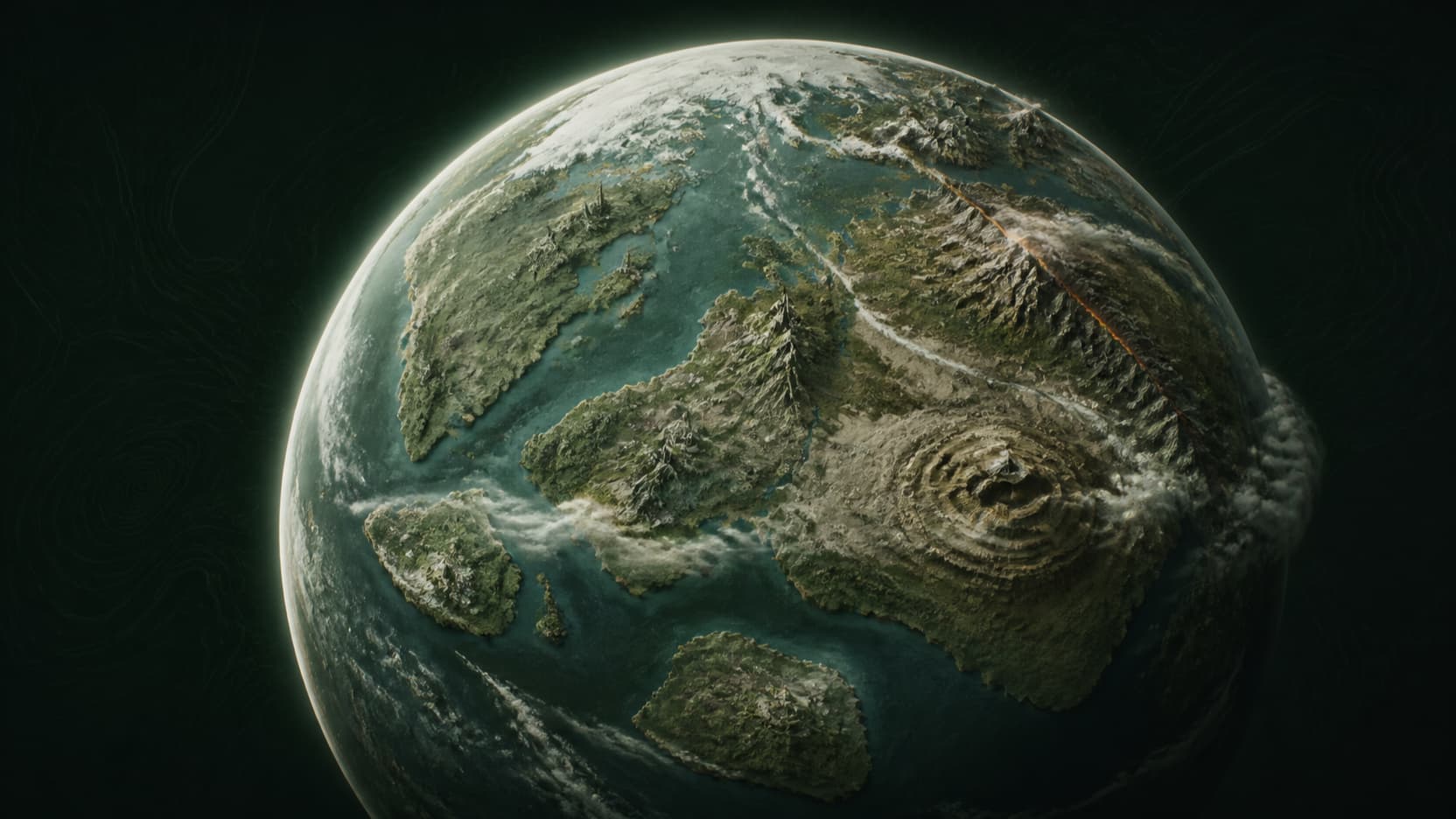
Ice caps, deserts, forests, volcanic belts and cloud systems should not be evenly sprinkled. Even fictional planets feel more coherent when latitude, elevation, water and prevailing weather leave visible patterns.
You do not need a full climate simulator to gain this effect. A few consistent relationships—wet windward coasts, dry interiors, bright equatorial storms, dark volcanic chains—give the viewer enough evidence to infer how the world works.
Section 04
Place landmark models where a story decision happens
A castle, lighthouse or rover is valuable when it changes how someone reads the map. The lighthouse implies a dangerous coast. The fortress identifies a political center. The rover turns an empty basin into an expedition route. Decorative repetition adds polygons; a well-placed landmark adds narrative.
Use a small object library first, then replace the most important silhouettes with custom models. This keeps exploration fast while preserving a clear path toward a more distinctive world.
Section 05
Test the jump from orbital beauty to playable scale
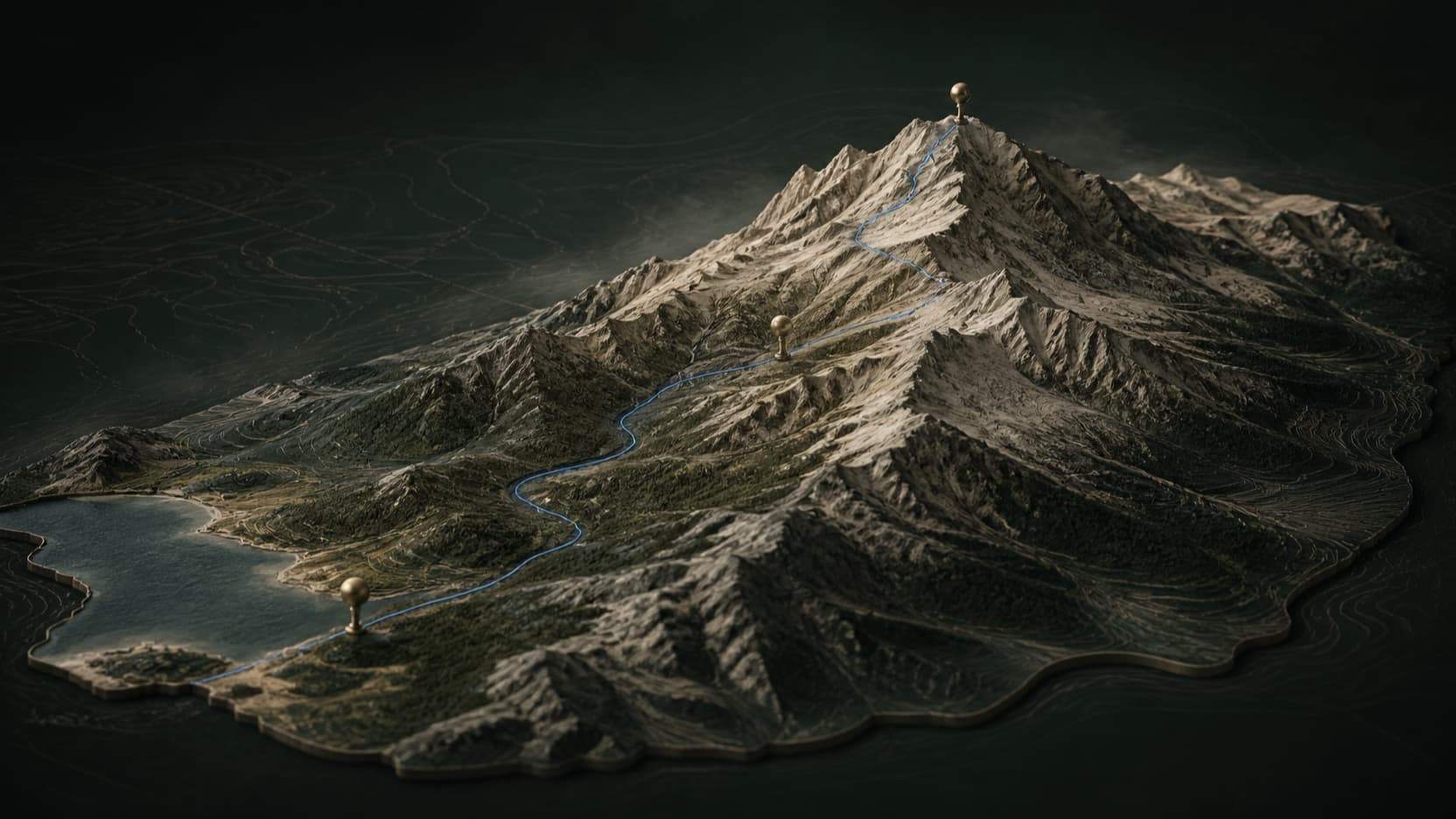
A planet can look excellent from orbit and fail as a place. Pick one point, descend to the surface and ask what the player or reader can do there. Is there a route, a destination, a resource conflict, a settlement edge or a reason to return?
Treat the orbital view as a promise and the surface view as proof. If the same world rule survives both scales, the planet is ready to support maps, scenes, game levels or a longer narrative bible.
A useful review loop is orbit → choose a point → explore locally → revise the global surface and landmark plan.
Section 06
Export a package, not just a beautiful sphere
Downstream work needs more than a screenshot. Keep the reviewed planet texture, scene model, separately reusable landmark models and notes about scale, orientation and source licenses together. For a game team, add a short engine guide and a list of which objects are decorative versus interactive.
A coherent package makes the planet useful after the first reveal. It can become a scene in a portfolio, a navigable story map, a reference for asset generation or a foundation for a playable world.
Quick reference
Frequently asked questions
What image shape should I use for a 3D planet texture?
A 2:1 equirectangular image is the common starting point. Its horizontal edges must join cleanly, and the poles need to be reviewed on the sphere.
How many landmarks should a worldbuilding planet have?
Start with only the landmarks that clarify routes, factions, resources or major story locations. Add density after the world's navigation remains readable.
Can I use generated 3D objects on the planet?
Yes, but each object still needs a scale, orientation, placement and quality review. Characters also need a dedicated rig and animation pipeline before they become playable avatars.